don't quote me but ...

quotes

"All the policemen, all the judges, all the politicians, all the public servants are working for the people. The people are the masters. Not the politicians. Or the public servants."

- Bill Southworth

"They are not doing anything!"

- participant about Vaka Councillors

"Well, that's a story too."

- Bill Southworth

"Whose information is it? Not theirs. Yours."

- Bill Southworth

yup, as simple as that

yup, as simple as that by jason brown avaiki nius agency Cultural Development Secretary Sonny Williams is interested in a piece of legislation designed to protect whistleblowers — people who speak out about abuse of power. “What’s it called?” “It’s called ‘The Whistleblowers Act,’” explains New Zealand Journalism Training Organisation Executive Director Bill Southworth. “Really?” asks Williams, eyes arching in disbelief. “Yes.” They laugh at the simplicity of it. Welcome to the weird world of the media where things are often exactly as they seem. Including whistleblowers, people on the inside who speak out publicly against abuse of power, often in government but in business as well. New Zealand only adopted the legislation a few short years ago. Before then, public servants and others could be prosecuted for exposing private information, even when it was clearly in the public interest to do so. Under the new legislation, whistleblowers are now protected if their allegations are serious enough. In other words, the worse the problem, the more protection whistleblowers get. Whistleblowers were one of several topics covered during day two of the media training workshop being held at Pukapuka hostel.

day one - government info is your info

by tara carr cook islands news Information held by government agencies is public information, participants were told at a media workshop yesterday. “The point here is that information that government holds on you is not theirs, it’s yours,” said Bill Southworth, the executive director of the New Zealand Journalism Training Organisation. “It’s not the property of the government, it’s the property of the public.” Around 15 people, including media representatives, government officials, prime minister Dr Robert Woonton – who opened the week-long workshop — and deputy prime minister Ngamau Munokoa, sat in on the session on freedom of information at the Pukapuka hostel yesterday morning. Southworth said that while most people do not exercise their right to access information, they rely on, and expect, the media to inform them on things that are happening in the community. “But the media has no more right than any citizen.” Southworth, who has previously worked as the editor of the Fiji Sun, touched on basic principles which underlie freedom of information laws, and he stressed that any proposed legislation should be guided by the principle of maximum disclosure. However he said that there are instances when agencies should not release information for reasons of national security, law enforcement, personal privacy or commercial secrecy. Workshop participants heard that having the right to freedom of information would help the public live in a less corrupt society, make sure their human rights are respected, help make the country more secure, lead to better decision-making, and help to make the political system more democratic. Article 64(e) of the Cook Islands constitution gives all Cook Islanders the right to freedom of speech and expression. Another session on freedom of information will be held this morning, beginning at 9am.

high public pressure equals low blood pressure

freedom of misinformation


comment by jason brown

avaiki nius agency


An audit officer asks whether media would report rumours if they could not get hold of the hard facts.

Sticky bun in one hand and instant coffee in the other, I consider the options.

“Yes.”

The audit officer smiles as if her worst suspicions are confirmed – the media really are a cheeky bunch of rascals.

“Yes, we would if government or someone else was refusing to release the facts.”

She keeps smiling. No excuse. Irresponsible reporting.

It is one of the great debates of journalism – when does a rumour become a fact? When enough people say it is? Or only when someone in authority confirms the rumour?

Years ago, a former private secretary to the then prime minister let rip with her frustrations.

“If you knew what was really going on you wouldn’t write any of those rumours,” she said accusingly.

Umm, well, yes. Exactly.

All too often, however, government refuses to discuss ‘what is really going on’ — and gets very annoyed when people refuse to stop talking about what might be going on.

Conjecturing. Speculating. Rumours, in other words.

Rumours become another sort of fact when more than a few people talk about them. Some news organisations wonÂ’t report a rumour unless they get it from three or more sources, hopefully credible ones. But, credible or not, it is often a fact that people are passing around rumours.

For example, controversy over pollution levels in Rarotonga lagoons started with rumours of people falling ill in Titikaveka.

Investigating, the media found that, yes, people said they were getting sick. Is it because of pollution? No one knows for sure. One boy died from what the prime minister described as blood poisoning. Any link with lagoon pollution was denied. Now many months later, government officials confirm that bacteria levels are five to ten times the World Health Organisation limits. Should the media hold back for months and months from reporting on rumours until the facts are known?

As the audit officer later said during session, rumours have the potential to cause a lot of harm and could be, for example, destructive of the economy.

True. But as a journalist told todayÂ’s meeting, 14 students who had been visiting from a New Zealand university all fell sick after swimming in the lagoon.

The rumours of lagoon pollution may not be true. Or the rumour may not yet be proven true. But they do exist.

“They emailed me and said that if they had known the lagoons were not safe they would have been more careful,” the reporter said.

One senior police officer called for careful handling of information that might cause damage to the countryÂ’s economy.

“It’s important that the media handles this information properly.”

Southworth said information like this should be released so the public has the facts.

“If you want to kill a tourist industry then try and hide something because if something happens then that will kill the industry.”

Something?

Until government opens up and presents the public with the facts, rumours — sensationalised, speculative misinformation, according to the critics — is often all the media have to go on.

And all the public has to protect themselves.


quote:

“The countries that have the least corruption have Freedom of Information legislation and the ones that are most corrupt don’t. So there’s got to be some message in that.”

— Bill Southworth

foi vs corruption

A more secure society? Some people had a hard time imagining troublemakers in the media contributing to national security but New Zealand Journalism Organisation executive director Bill Southworth explained how freedoms of information works its magic. foi vs corruption Would FOI — freedom of information legislation — really change anything? What are the kinds of things it might expose? Participants were asked to come up with situations where FOI laws might help stop, real life examples or not. Travel abuse was one. “When I asked about travel they told me that we live in a global village. We don’t live on an island on our own. We are obligated to be at these meetings,” said one reporter. “That’s true,” responded Southworth. He gave the environment and global warming as examples of important international issues, especially for islands not very high above rising sea levels.

But,” even so, “each time they travel, they should still have to justify it.” This brought other examples of corruption, including > a minister who travelled to Saudi Arabia to learn how to grow lemons. > another minister who went to Israel to learn how to grow oranges. > more recently, ministers who have gone to the Olympics to act as “spectators.” > funds taken from the Outer Islands Development Grant Fund. > controversial New Zealand property developer Mark Lyons being given a 12 month residency permit. > awarding of government contracts, allegedly without proper due process. “Corruption is like a cancer,” says Southworth. “It starts to kill the body of the state.”Doubts remain about the strength of arguments for FOI laws. “If the three legs of the stool — the government, courts and parliament — are not independent from each other, then what’s the point of having freedom of information?” asked one reporter. She had seen many stories written on the quarterly audit reports come to nothing. Institutions like the Public Service Commission and the Ombudsman would do nothing even when faced with multiple media reports. Not only here but in countries like Fiji, where $14 million in local purchasing orders walked out the door of one ministry, people lining up to get everything from rakes to outboard motors for themselves, she said. You can pass all the rules and regulations you like, said one audit officer in response, “but it really comes down to the calibre of the leaders voted by the people. If they are also bad leaders then there will be bad government.” Southworth says this is why it is important media have access to freedom of information laws. “How can voters make an informed choice if they don’t know what has been going on?” Voting is not so much for the opposition as against the government because “when we vote for the opposition, we don’t really know what they are like.” Oh no? “It just takes one month,” observed one participant, dryly.

freedom of misinformation

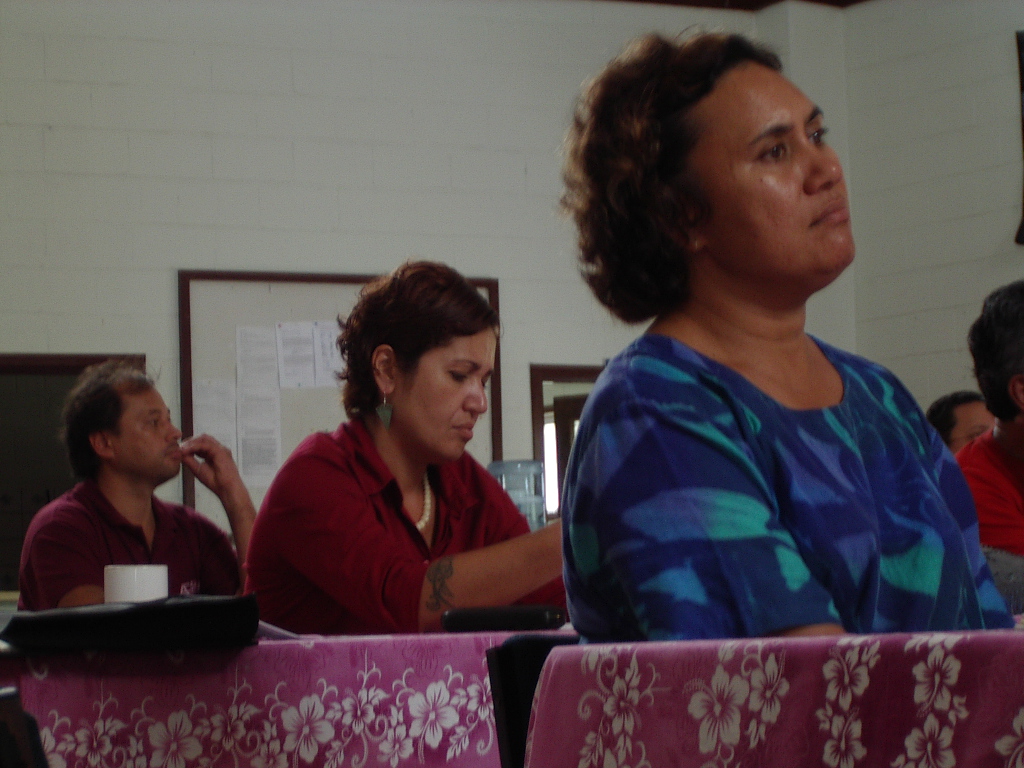
Listening hard: Ian Bertram, Florence Syme Buchanan and Vaine Wichman, one of only two MPs at day two of the media training workshop, the other being Deputy Prime Minister Ngamau Munukoa. Prime Minister Dr Robert Woonton was at the first day, the highest level interest yet shown to freedom of information discussions. comment by jason brown avaiki nius agency An audit officer asks whether media would report rumours if they could not get hold of the hard facts. Sticky bun in one hand and instant coffee in the other, I consider the options. “Yes.” The audit officer smiles as if her worst suspicions are confirmed – the media really are a cheeky bunch of rascals. “Yes, we would if government or someone else was refusing to release the facts.” She keeps smiling. No excuse. Irresponsible reporting. It is one of the great debates of journalism – when does a rumour become a fact? When enough people say it is? Or only when someone in authority confirms the rumour? Years ago, a former private secretary to the then prime minister let rip with her frustrations. “If you knew what was really going on you wouldn’t write any of those rumours,” she said accusingly. Umm, well, yes. Exactly. All too often, however, government refuses to discuss ‘what is really going on’ — and gets very annoyed when people refuse to stop talking about what might be going on. Conjecturing. Speculating. Rumours, in other words. Rumours become another sort of fact when more than a few people talk about them. Some news organisations won’t report a rumour unless they get it from three or more sources, hopefully credible ones. But, credible or not, it is often a fact that people are passing around rumours. For example, controversy over pollution levels in Rarotonga lagoons started with rumours of people falling ill in Titikaveka. Investigating, the media found that, yes, people said they were getting sick. Is it because of pollution? No one knows for sure. One boy died from what the prime minister described as blood poisoning. Any link with lagoon pollution was denied. Now many months later, government officials confirm that bacteria levels are five to ten times the World Health Organisation limits. Should the media hold back for months and months from reporting on rumours until the facts are known? As the audit officer later said during session, rumours have the potential to cause a lot of harm and could be, for example, destructive of the economy. True. But as a journalist told today’s meeting, 14 students who had been visiting from a New Zealand university all fell sick after swimming in the lagoon. The rumours of lagoon pollution may not be true. Or the rumour may not yet be proven true. But they do exist. “They emailed me and said that if they had known the lagoons were not safe they would have been more careful,” the reporter said. One senior police officer called for careful handling of information that might cause damage to the country’s economy. “It’s important that the media handles this information properly.” Southworth said information like this should be released so the public has the facts. “If you want to kill a tourist industry then try and hide something because if something happens then that will kill the industry.” Something? Until government opens up and presents the public with the facts, rumours — sensationalised, speculative misinformation, according to the critics — is often all the media have to go on. And all the public has to protect themselves. quote: “The countries that have the least corruption have Freedom of Information legislation and the ones that are most corrupt don’t. So there’s got to be some message in that.” — Bill Southworth

bill's pen is mightier than the family sword

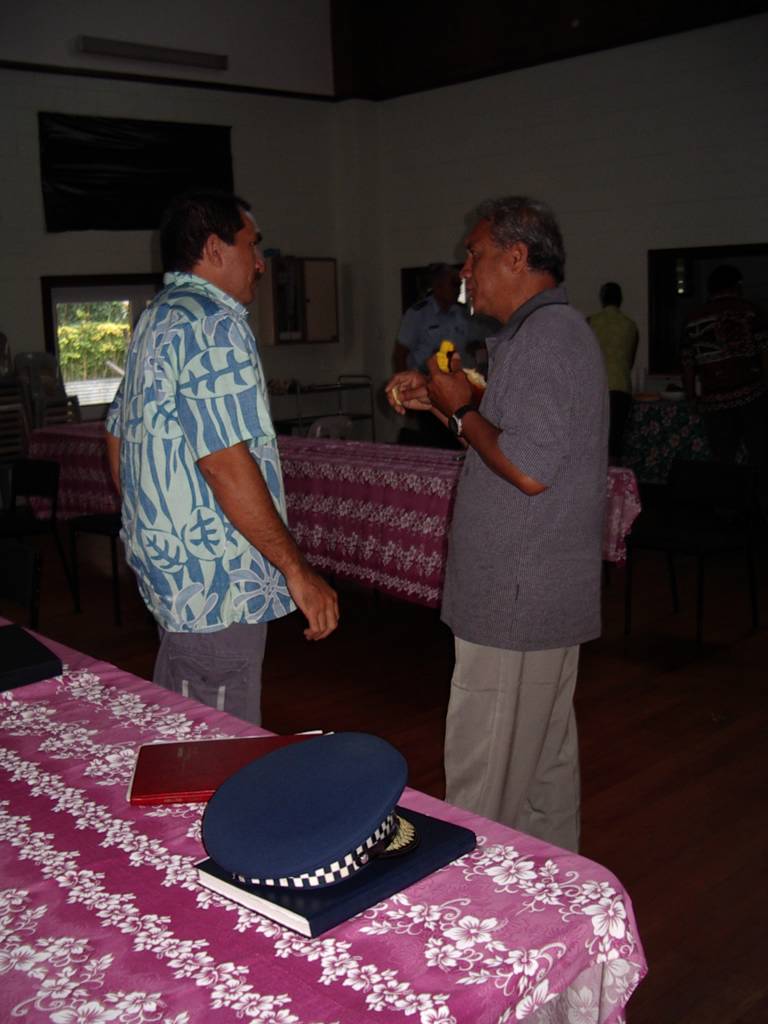
Deputy Police Commissioner Maara Tetava takes morning tea with Rev. Ngarima George. is the pen is mightier than the sword? Do the heads of ministries report to their ministers? “Yes.” Do the ministers report to cabinet? “Yes.” Does the minister table that report in Parliament? “Yes.” So it was claimed at today’s session on Freedom of Information but is that really the reality? “Supposed to be,” said one participant. Part of the problem is that countries like the Cook Islands are being expected to absorb in a few short decades concepts of democracy that have been in development for 2,000 years. More recently, for example, “my ancestors came from Normandy,” explained NZJTO's Bill Southworth. “They had a big sword.” Democracy as it is today has a history drenched in blood from swords like Southworth's family, with many kings (and queens) beheaded, battles fought, pain and anguish suffered by countless people. Many died so people could vote freely. Any denial today of freedom of information is based on an “an antiquated view of leadership between people and their governments,” says Southworth. Maybe, said one participant. But some might still object to someone like Southworth coming in and trying to tell people what to. “Why are you going into the affairs of my country?” said the participant, jokingly imagining criticism such as “You are a s*** stirrer!” Certainly, replied Southworth, this is why it people in each country need to debate what form of freedom of information laws are appropriate to them. Besides, he teased back, “I’m a journalist. I’ve been a s*** stirrer from day one.” Better the pen than the sword.