

avaiki - transparency - revenue update
payment received from: Islands Business International $1,111 for: stories received and commissioned from Jason Brown see www.islandsbusiness.com
wong dismisses nuclear fallout concerns
The Cook Islands government is dismissing a claim some residents of the northern group may have been affected by British nuclear weapons testing on Christmas Island in the 1950s.
The British interior ministry, the Home Office, has failed to give a full response to a letter written by Tauariki Greig, who used to live on Rakahanga in the northern Cook Islands.
Mrs Greig says her mother and father were affected by the tests, and her own present illness stems from when she witnessed one explosion in 1957.
“We were playing hide and seek. Kids. And I was on my father’s shoulders when it happened. I saw a flash, like lightning, and killed all the fish.”
Mrs Greig says DNA testing in New Zealand points to genetic mutations as the cause of cancer-like symptoms.
She told Radio New Zealand International she wants the Cook Islands to carry out a full study into the possible health effects of the tests, and for compensation to be awarded.
An official in the prime minister’s office, Helen Wong, has dismissed the claims, suggesting Rakahanga is too far away from the test site to be affected.
pacific church council backs debate

// PRESS RELEASE
For immediate release
May 20 2005
"ECONOMIC PARTNERSHIP AGREEMENTS NEED TO BE DISCUSSED AT ALL LEVELS"
It is time that important agreements such as economic partnership and trade agreements are discussed at all levels and not be reserved "for the experts only" as they affect the lives of everyone said two non-governmental organisations.
According to the World Council of Churches (WCC) Office the Pacific and the Pacific Network on Globalisation (PANG), "The Economic Partnership Agreement and PACER and PICTA are mechanisms that will affect the lives of all Pacific Islanders and as such they are important issues that need to be discussed at all levels."
WCC's Office in the Pacific's Executive Secretary Fe'iloakitau Kaho Tevi said the churches in the Pacific are now called to respond to the consequences of global economic policies that marginalize and exclude more Pacific Islanders than ever before.
Referring to Professor Jane Kelsey's report "A People's Guide to the Pacific's Economic Partnership Agreement" which was commissioned by the WCC Office in the Pacific, Tevi said the study hopes to bring such broad sweeping concepts to a level that is understandable to all in the hope that discussion is generated at all levels and that an increasing number of Pacific Islanders understand the trade negotiations and multilateral trade agreements our governments are signing up to on our behalf.
"More importantly, it is our hope that this study will bring people together to live and advocate for a more just economic system that is more viable and more sustainable for all, and that does not and will not create second class citizens," he said.
PANG Interim Coordinator Shelly Rao said the release of this report was timely as Pacific ACP Ministers and Trade Ministers meet in Nadi from 23-27 May 2005 to discuss important issues such as investment, tourism and fisheries. "Most Pacific Islanders are not aware about the consequences of such agreements. We do our best to raise awareness on such issues but this report is a great awareness tool as it dissects such agreements" she said.
Professor Jane Kelsey who is a Professor of Law at the University of Auckland, New Zealand will be launching her report in Nadi on Monday 23 May 2005. She is also the author of the interim report entitled Big Brothers Behaving Badly: The Implications for the Pacific Islands of the Pacific Agreement on Closer Economic Relations (PACER) and the final report A People's Guide to PACER, produced for PANG in 2004. She is a board member of the Action, Research and Education Network of Aotearoa (ARENA)
For more information please contact Mr Fei Tevi e-mail: fkt@wcc-coe.org Ph: (679) 3317 509 or Shelly Rao coordinator@pang.org.fj Ph: (679) 3316 722/ 9932 313
avaiki - transparency - revenue disclosure
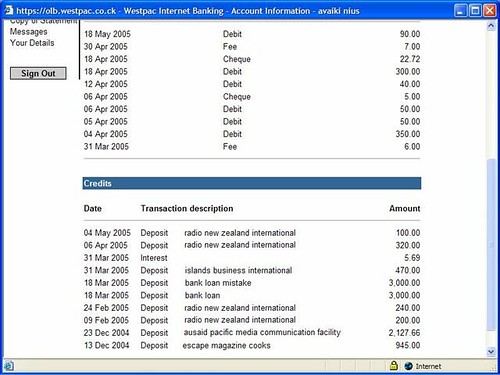
// AVAIKI - TRANSPARENCY - REVENUE DISCLOSURE to Wednesday 18th May 2005
As can be seen above, it's been a slow year financially for Avaiki founder Jason Brown.
"Most of my time has been spent educating myself about blogs and their role in the publishing revolution going on right now. Hopefully that investment will return much better income streams as Avaiki progresses."
All of the income is from freelance sources, rather than this website.
dawn of the nuclear age
// NEWS
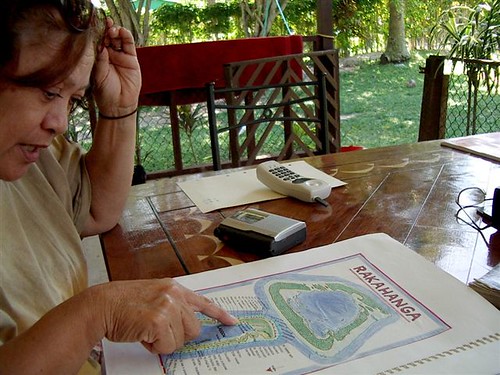
Tauariki Greig was just 10 years old, playing hide and seek, when she saw a flash "brighter than the sun."
Greig had just been introduced to the nuclear age.
Nearly half a century later, British authorities are the ones hiding.
ground zero: nuclear terrorism?
// EDITORIAL / OPINION
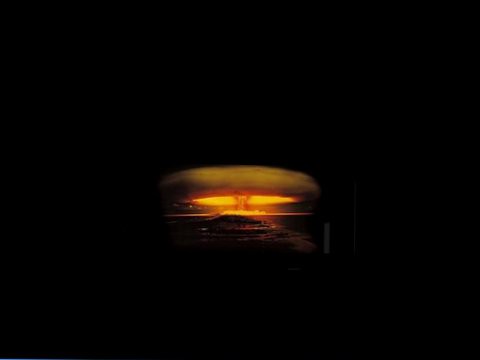
So far, we have first-world nations paying compensation to some of their nuclear test veterans.
When, we wonder, will this extend to everyone in fallout zones?
Including pacific islanders?
How many illnesses, deaths, media stories, court cases and public scandals will it take to get various governments to face up to their multi-billion dollar (and pound) responsibilities from the dawn of the nuclear age?
A very great many, no doubt.
Strategically speaking, it might pay our closest trading partner to align itself with the cause of pacific islanders, rather than continue to participate in fobbing off public inquiry.
New Zealand has historic precedent to do so, bravely stepping forward at one ground zero, Moruroa.
She needs to do so again.
To do less would be to reinvite accusations that New Zealand is soft on nuclear terrorism.
France and her nuclear allies got away with the Rainbow Warrior bombing, a near-final insult after decades of nuclear tests in the south pacific.
Now increasing numbers are falling sick from suspected long-term effects of nuclear test fallout.
letter exposes 1957 hydrogen bomb tests
// NEWS
Growing numbers of international news reports about high numbers of cancers and other lethal diseases linked to nuclear testing in the fifties and sixties have now been joined by the Cook Islands.
In a copy of a letter given to avaiki nius agency, former Rakahanga resident Tauariki Greig recalls being exposed to the 1957 hyrdogen bomb test by the British government on Christmas Atoll.
“I was playing hide and seek with my family; my father had hoisted me onto his shoulders to help me hide in a tree. It was a beautiful sunny clear day and I will never forget the flash of light brighter than the sun," says Greig in her letter.
Sent to the Home Office in London, Greig got a routine response asking for copies of all correspondence.
No further response was forthcoming.
"Shortly after" the blast, says Greig, "the ground shook. We didn’t know what was going to happen. That evening the whole sky turned red.
"It stayed like that for about a week. A few days after the blast our lagoon changed colour and all of the fish died; floated to the surface. Our parents wouldn’t let us eat the fish so the men buried them.”
Greig says DNA testing in New Zealand reveals genetic mutation as a possible explanation for cancer like symptoms she is suffering, nearly half a century later.
file shot: cyclone season 2004
// ARCHIVES
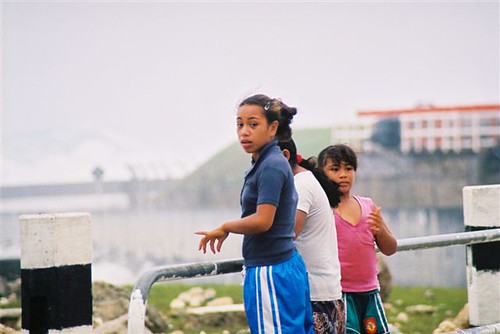
Hurricane holiday: young students line up along roadside railing at the Nikao airport seawall during a cyclone alert last year. Sea surge from this year's cyclones was higher.
Subscribe to:
Posts (Atom)