
 NEWS
Environmental taxes will gather $900,000 for the government of the Cook Islands in the current financial year.
Not one dollar of that will be spent on a full time climate change worker.
Lack of focus on climate change follows years of random approaches to the issue.
“We had problems with lost files so we are trying to build a database,” reports Pasha Carruthers, Climate Change Technical Officer for the National Environment Services.
Carruthers says the country lacks a consistent approach to climate change.
“There’s still a lot of work being done by different agencies. A country team has not been maintained. Staff are only project based. For example, I went from this project, to Mauke and Aitutaki. If there’s no projects, there’s no climate change person at any agency driving this process full time so there’s a risk that there’s no continuity.”
Government is increasingly out of step with increasing awareness and action on climate change.
Bishop Stuart O’Connell says the Catholic church has strong instructions from Rome to seek action.
“We have been told to get cracking on this issue.
“We have a conference on Bishops in Fiji and August and have been told to gather information for this.”
Nor is this the first time.
“It was first raised by 25 years ago but it wasn’t picked up by anyone then.”
Now it has.
More than 40 people attended the first day of the WWF and National Environment Services workshop on climate change.
Participants were given two stick-on dots – one pink, one green – and asked to apply one each to posters representing eight different sectors
Participants ranked impacts on water as the number one concern under climate change.
Infrastructure and coastal protection were ranked second and third.
Tourism ranked a surprising last as a priority area to address in potential impacts from climate change.
Just one person put a sticker under tourism, and only as second priority.
Such a ranking reflects low importance placed on tourism despite it being the country’s number one industry.
NEWS
Environmental taxes will gather $900,000 for the government of the Cook Islands in the current financial year.
Not one dollar of that will be spent on a full time climate change worker.
Lack of focus on climate change follows years of random approaches to the issue.
“We had problems with lost files so we are trying to build a database,” reports Pasha Carruthers, Climate Change Technical Officer for the National Environment Services.
Carruthers says the country lacks a consistent approach to climate change.
“There’s still a lot of work being done by different agencies. A country team has not been maintained. Staff are only project based. For example, I went from this project, to Mauke and Aitutaki. If there’s no projects, there’s no climate change person at any agency driving this process full time so there’s a risk that there’s no continuity.”
Government is increasingly out of step with increasing awareness and action on climate change.
Bishop Stuart O’Connell says the Catholic church has strong instructions from Rome to seek action.
“We have been told to get cracking on this issue.
“We have a conference on Bishops in Fiji and August and have been told to gather information for this.”
Nor is this the first time.
“It was first raised by 25 years ago but it wasn’t picked up by anyone then.”
Now it has.
More than 40 people attended the first day of the WWF and National Environment Services workshop on climate change.
Participants were given two stick-on dots – one pink, one green – and asked to apply one each to posters representing eight different sectors
Participants ranked impacts on water as the number one concern under climate change.
Infrastructure and coastal protection were ranked second and third.
Tourism ranked a surprising last as a priority area to address in potential impacts from climate change.
Just one person put a sticker under tourism, and only as second priority.
Such a ranking reflects low importance placed on tourism despite it being the country’s number one industry.
random response to climate change

cyclones double in 30 years
 NEWS
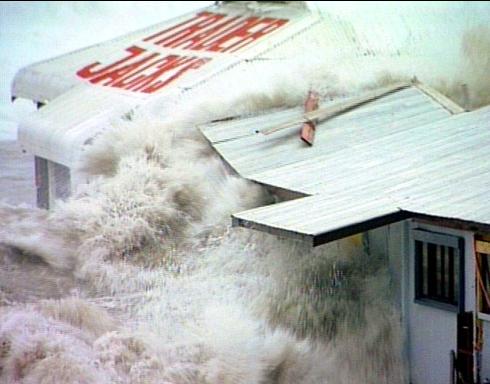
During cyclone Meena last year, waves smashed up 13 metre high cliffs in Mangaia, southern most of the Cook Islands, took out two houses at the top and ran a further 50 metres inland.
“Just imagine a couple of those hitting here,” warns coastal protection developer Don Dorrell on the first day of a climate change workshop on Rarotonga.
Meena was one of five cyclones that struck Cook Islands last year, all of them high intensity events.
“You have to remember that none of these cyclones actually hit us,” says Dorrell.
All five were near misses.
Severe cyclones have more than doubled in number in the last 30 years, according to figures quoted by Dorrell.
Atmospheric scientist Kerry Emanual published an extensive study of 4,800 hurricanes over the last 30 years of satellite tracking.
“His findings are as damning as they are scary,” says Dorrell.
Category four and five cyclones are the most damaging.
These have risen from 17 between 1970 and 1974 to 37 extreme cyclones between 2000 and 2004.
“There’s only one problem with this graph is that it stops in 2004,” says Dorrell, “so that it doesn’t include the likes of Katrina and the four or five that went through us here in the Cook Islands.”
Many Rarotonga residents remember Cyclone Sally in 1987 that did hit but was only a category one cyclone.
Category one cyclones have actually decreased from 43 at the start of the 1970’s to 29 at the start of the 2000’s, while category two and three remain stable at around 40 events.
If this trend continues, the number of extreme cyclones will double again within 15 years, and double again in less than a decade after that.
At the same time, sea levels across the Pacific will rise, delegates at the World Wildlife Fund climate change workshop were told today.
By 2020, sea level will be nine centimetres higher than they were in 1990.
“Up in the northern group of the Cook Islands, most of the islands are one metre or one and a half metres above sea level,” says Maara Vaiimene from the Meterological Office.
“The sea can also cause coastal flooding with people living near the coast.”
Coastal flooding is expected to worsen well before 2060, when sea level rise will be as much as 28 centimetres.
“Here in Rarotonga because we are quite a high place in the coastal areas we don’t worry about the impacts of sea level rise.”
Like the northern Cooks, most of the region’s islands are low atolls.
Future sea level rises come on top of an estimated 10 to 25 centimetres rise already in the last century between 1906 and 2006.
Rates of climate change impacts are about to increase rapidly, replacing decades of slow change, according to WWF officials.
“Over the last 200 years the amount of carbon dioxide in the atmosphere has increased by about a third. Over the next 30 years the carbon dioxide is going to increase by 60 per cent,” says WWF’s Jyotishma Rajan.
“So we should be worried.”
Presenting the sea level rise figures, Rajan quoted from figures put together by Ian Fry, International Environment Issues Adviser to the government of Tuvalu, an all-atoll nation which has taken a lead role in raising awareness of impacts on low lying islands.
Climate change sceptics have previously dismissed effects of global warming saying global temperatures have risen by less than one degree.
Rajan confirms the percentage.
“Since 1860 global temperatures have risen by an average of 0.8 degrees. But remember that when you go to the doctor a rise of just one percent means that you are quite ill.”
But averages do not provide the full picture of weather extremes.
“The world has never experienced a year as hot as 2005. It was the hottest year on record,” says Rajan.
“By 2100 temperatures will be 1.6 degrees to 5 degrees hotter than they are now.”
Already, at less than one percent increase, “scientists are saying and I find this fact quite alarming that the average storm is lasting 60 percent longer and the wind speeds 15 percent higher.”
Dorrell told participants that this year has already seen the world’s most powerful cyclone off Australia and that weather scientists are considering if there is a need to add a new category.
photo: Geoff Mackley www.rambocam.com
NEWS
During cyclone Meena last year, waves smashed up 13 metre high cliffs in Mangaia, southern most of the Cook Islands, took out two houses at the top and ran a further 50 metres inland.
“Just imagine a couple of those hitting here,” warns coastal protection developer Don Dorrell on the first day of a climate change workshop on Rarotonga.
Meena was one of five cyclones that struck Cook Islands last year, all of them high intensity events.
“You have to remember that none of these cyclones actually hit us,” says Dorrell.
All five were near misses.
Severe cyclones have more than doubled in number in the last 30 years, according to figures quoted by Dorrell.
Atmospheric scientist Kerry Emanual published an extensive study of 4,800 hurricanes over the last 30 years of satellite tracking.
“His findings are as damning as they are scary,” says Dorrell.
Category four and five cyclones are the most damaging.
These have risen from 17 between 1970 and 1974 to 37 extreme cyclones between 2000 and 2004.
“There’s only one problem with this graph is that it stops in 2004,” says Dorrell, “so that it doesn’t include the likes of Katrina and the four or five that went through us here in the Cook Islands.”
Many Rarotonga residents remember Cyclone Sally in 1987 that did hit but was only a category one cyclone.
Category one cyclones have actually decreased from 43 at the start of the 1970’s to 29 at the start of the 2000’s, while category two and three remain stable at around 40 events.
If this trend continues, the number of extreme cyclones will double again within 15 years, and double again in less than a decade after that.
At the same time, sea levels across the Pacific will rise, delegates at the World Wildlife Fund climate change workshop were told today.
By 2020, sea level will be nine centimetres higher than they were in 1990.
“Up in the northern group of the Cook Islands, most of the islands are one metre or one and a half metres above sea level,” says Maara Vaiimene from the Meterological Office.
“The sea can also cause coastal flooding with people living near the coast.”
Coastal flooding is expected to worsen well before 2060, when sea level rise will be as much as 28 centimetres.
“Here in Rarotonga because we are quite a high place in the coastal areas we don’t worry about the impacts of sea level rise.”
Like the northern Cooks, most of the region’s islands are low atolls.
Future sea level rises come on top of an estimated 10 to 25 centimetres rise already in the last century between 1906 and 2006.
Rates of climate change impacts are about to increase rapidly, replacing decades of slow change, according to WWF officials.
“Over the last 200 years the amount of carbon dioxide in the atmosphere has increased by about a third. Over the next 30 years the carbon dioxide is going to increase by 60 per cent,” says WWF’s Jyotishma Rajan.
“So we should be worried.”
Presenting the sea level rise figures, Rajan quoted from figures put together by Ian Fry, International Environment Issues Adviser to the government of Tuvalu, an all-atoll nation which has taken a lead role in raising awareness of impacts on low lying islands.
Climate change sceptics have previously dismissed effects of global warming saying global temperatures have risen by less than one degree.
Rajan confirms the percentage.
“Since 1860 global temperatures have risen by an average of 0.8 degrees. But remember that when you go to the doctor a rise of just one percent means that you are quite ill.”
But averages do not provide the full picture of weather extremes.
“The world has never experienced a year as hot as 2005. It was the hottest year on record,” says Rajan.
“By 2100 temperatures will be 1.6 degrees to 5 degrees hotter than they are now.”
Already, at less than one percent increase, “scientists are saying and I find this fact quite alarming that the average storm is lasting 60 percent longer and the wind speeds 15 percent higher.”
Dorrell told participants that this year has already seen the world’s most powerful cyclone off Australia and that weather scientists are considering if there is a need to add a new category.
photo: Geoff Mackley www.rambocam.com
population drops below 12,000
NEWS
Migration continues to affect the Cook Islands with the resident population dropping to below 12,000.
Resident population stood at 11,800 in December 2005, according to figures released by the Statistics Office this week.
Resident figures are sure to cause confusion as total population continues to climb with an end of year figure of 21,600.
This is 4,600 more visitors than were in the country at the beginning of 2000, when the total population was 17,000 – and residents were calculated at 15,000.
Government has not offered any explanations for the huge gap between resident and total population.
Nor have government leaders responded to public calls for a survey into migration losses, including reasons why Cook Islanders are still leaving – mostly for Australia and New Zealand - despite continued economic growth.
However the number of Cook Islanders declaring they were leaving the country “permanently” has doubled.
In 2001, 195 people ticked this box on departure. Last year, 415 people did so.
An astonishing 12,769 residents are counted by Statistics as leaving the country last year, for a variety of reasons including vacation, business and, by far the biggest group at 5,486, visiting friends and relations.
Just five said they were leaving for work or education.
In 1993, government promised to survey workers on labour conditions and followed that up with another promise to similarly survey migrants.
Neither survey has ever been done.
No mention is made of the surveys in the latest government policy document, the March Budget Policy Statement.
“It is recognized that the outer islands face significant development issues as resources available to promote economic and social well being are limited. The drift of population to Rarotonga and overseas is evident and contributes to the capacity constraints faced by the outer islands. “Government intends to address these challenges by providing a better
coordinated approach towards sustainable development that will provide support to both private and public sector operations in the outer islands.”
Calls by MFEM officials last year to address the migration issue appear to have been dropped.
More positively for workers, government has announced an increase in the minimum wage from $4 to $5 an hour – a 25% increase.
One observer says that the size of the increase – and the lack of criticism from the private sector - suggests wages have been too low for some time, possibly contributing to migration.
According to the Consumer Price Index, costs of living have increased 23% since 1998, with food and housing the highest risers.